Loading...
- Home
- Capabilities
- ACTIO® Hub
- About Us
- Connect with Us
- AP Library
January 27, 2025
Indonesia’s Port State Control (PSC) system ensures foreign ships comply with international maritime safety, security, and environmental standards. Governed by Law No. 17/2008 on Shipping (amended in 2024), the system empowers the Harbormaster and Port Authority to:
Key Authorities:
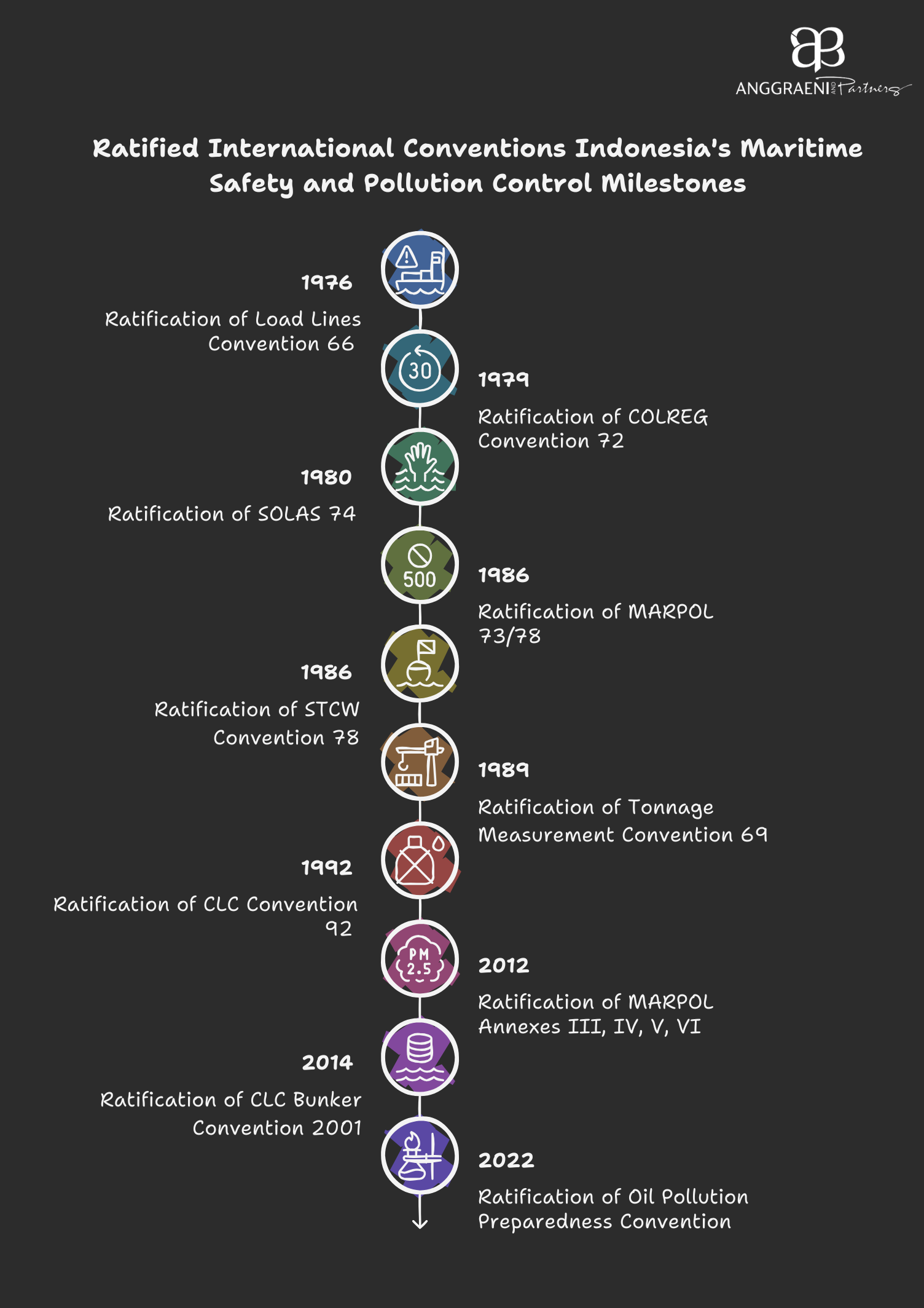
Indonesia has ratified several key international conventions that underpin these inspections, including:
Understanding Indonesia’s PSC system is critical for:
Our team is here to help. Contact below author to discuss more.
This disclaimer applies to the publication of articles by Anggraeni and Partners. By accessing or reading any articles published by Anggraeni and Partners, you acknowledge and agree to the terms of this disclaimer:
During the preparation of this work, the author(s) may use AI-assisted technologies for readability. After using this tool/service, the author(s) reviewed and edited the content as needed for the purposes of the publication.
No Legal Advice: The articles published by Anggraeni and Partners are for informational purposes only and do not constitute legal advice. The information provided in the articles is not intended to create an attorney-client relationship between Anggraeni and Partners and the reader. The articles should not be relied upon as a substitute for seeking professional legal advice. For specific legal advice tailored to your individual circumstances, please consult a qualified attorney.
Accuracy and Completeness: Anggraeni and Partners strive to ensure the accuracy and completeness of the information presented in the articles. However, we do not warrant or guarantee the accuracy, currency, or completeness of the information. Laws and legal interpretations may vary, and the information in the articles may not be applicable to your jurisdiction or specific situation. Therefore, Anggraeni and Partners disclaim any liability for any errors or omissions in the articles.
No Endorsement: Any references or mentions of third-party organizations, products, services, or websites in the articles are for informational purposes only and do not constitute an endorsement or recommendation by Anggraeni and Partners. We do not assume responsibility for the accuracy, quality, or reliability of any third-party information or services mentioned in the articles.
No Liability: Anggraeni and Partners, its partners, attorneys, employees, or affiliates shall not be liable for any direct, indirect, incidental, consequential, or special damages arising out of or in connection with the use of the articles or reliance on any information contained therein. This includes but is not limited to, loss of data, loss of profits, or damages resulting from the use or inability to use the articles.
No Attorney-Client Relationship: Reading or accessing the articles does not establish an attorney-client relationship between Anggraeni and Partners and the reader. The information provided in the articles is general in nature and may not be applicable to your specific legal situation. Any communication with Anggraeni and Partners through the articles or any contact form on the website does not create an attorney-client relationship or establish confidentiality.
By accessing or reading the articles, you acknowledge that you have read, understood, and agreed to this disclaimer. If you do not agree with any part of this disclaimer, please refrain from accessing or reading the articles published by Anggraeni and Partners.

P: 6221. 7278 7678, 72795001
H: +62 811 8800 427
Anggraeni and Partners, an Indonesian law practice with a worldwide vision, provides comprehensive legal solutions using forward-thinking strategies. We help clients manage legal risk and resolve disputes on admiralty and maritime law, complicated energy and commercial issues, arbitration and litigation, tortious claims handling, and cyber tech law.
S.F. Anggraeni
Managing Partner
Reynalda Basya Ilyas
Managing Associate
reynalda.bi@ap-lawsolution.net
Agnes Wulandari
Associate
agnes.wd@ap-lawsolution.net
Orima Melati Davey
Legal Researcher
Ocean-Maritime-Climate Research Group
orima.md@ap-lawsolution.net
Christou Imanuel Siregar
Legal Researcher
Ocean-Maritime-Climate Research Group
christou.is@ap-lawsolution.net