
Navigating Maritime Cyber Risk in Indonesia: Law, Liability, and the Digital Future
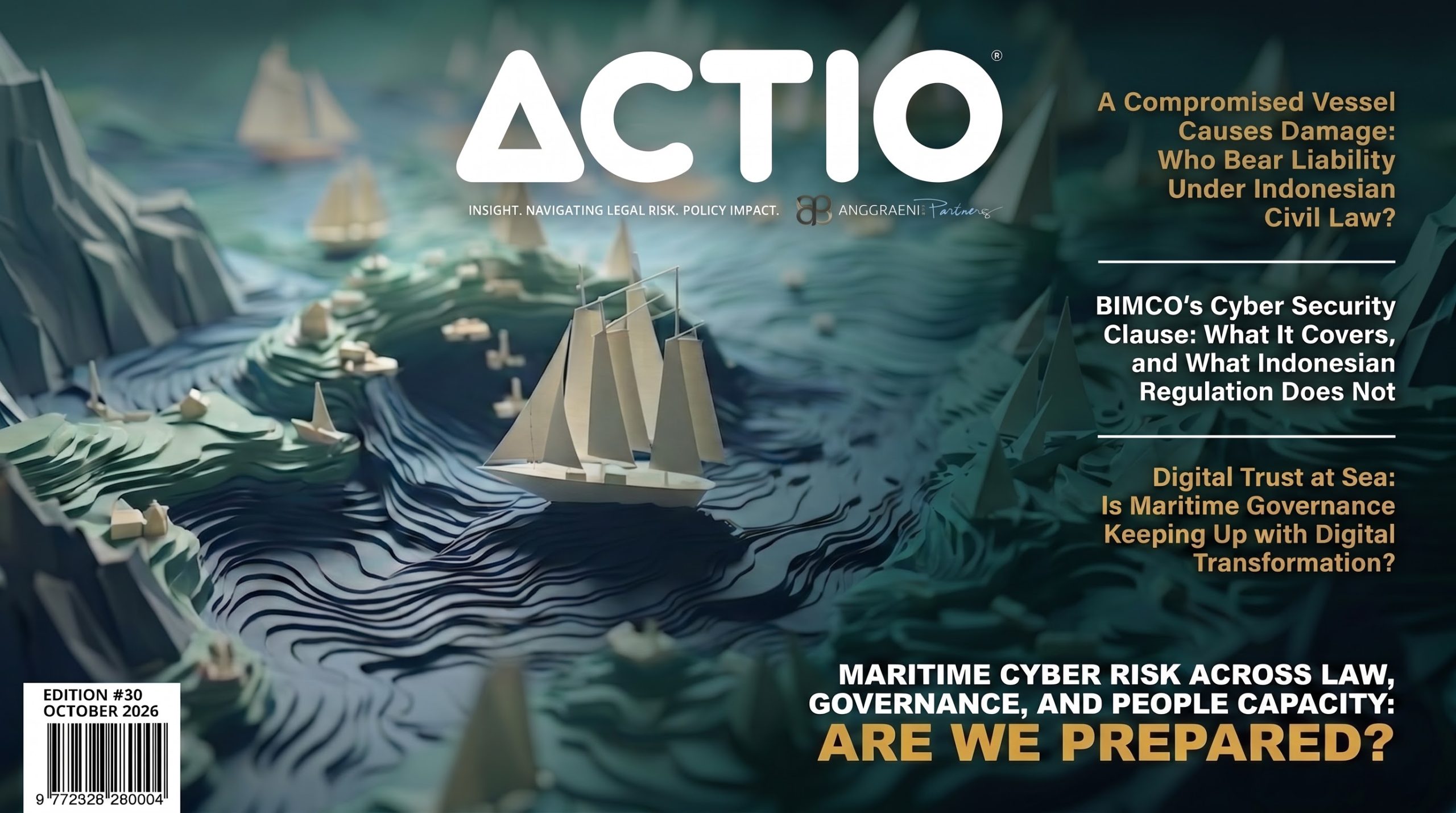
Executive Summary: As the maritime sector accelerates its digital transformation, reliance on interconnected operational technology (OT) and information technology (IT) has exposed global supply chains to unprecedented cyber threats. Drawing from the insights published in ACTIO Magazine Edition #30, this article examines Indonesia’s readiness to address maritime cybersecurity from a legal, governance, and human capital perspective.
The Regulatory Gap: Indonesia vs. IMO Standards
Modern maritime operations rely heavily on automated systems, making them highly susceptible to cyberattacks that can disrupt logistics and compromise vessel safety. While the International Maritime Organization (IMO) has integrated cyber risk management into the International Safety Management (ISM) Code, Indonesia currently lacks a dedicated maritime cybersecurity legal framework.
Instead, the industry must navigate a fragmented landscape of cross-sectoral regulations:
-
Electronic Information and Transactions (ITE) Law: Mandates reliable system operations but lacks maritime-specific operational protocols.
-
Personal Data Protection (PDP) Law: Focuses on data breaches rather than operational technology failures.
-
Shipping Law (Law No. 17 of 2008): Regulates physical seaworthiness and navigation safety without explicitly mandating cyber risk integration.
This fragmentation creates a critical governance challenge, demanding that shipping operators proactively align their internal compliance with international IMO standards to mitigate legal exposure.
Managing Financial Fallout: Marine Insurance Limitations
When a cyber incident occurs, the immediate question turns to financial recovery. However, traditional marine insurance policies—such as Hull and Machinery (H&M) or Protection and Indemnity (P&I)—were not designed for digital perils.
-
The Cyber Exclusion Clause: Many standard policies utilize clauses like the LMA5402, which explicitly exclude losses arising from cyber-related events.
-
Proactive Contract Review: Maritime stakeholders must conduct rigorous reviews of their policy wordings to identify uninsured exposures. Without standalone marine cyber insurance or specific buy-back endorsements (like LMA5403), operators may bear the full financial brunt of a system breach.
Bridging the Gap with Contracts: The BIMCO Clause
In the absence of robust public regulation, private contractual allocation does the heavy lifting. The BIMCO Cyber Security Clause 2019 serves as a vital contractual mechanism for charterparties and port agreements governed by Indonesian law.
By incorporating this clause, maritime actors can establish clear parameters for cyber risk:
-
Reciprocal Obligations: Requires all parties to implement adequate cybersecurity measures and incident-response procedures.
-
Liability Caps: Establishes a default liability cap of USD 100,000 for breaches, preventing catastrophic financial ruin from a single compromised system.
-
Incident Notification: Mandates a strict 12-hour window to share mitigation information following a breach.
Victim or Suspect? Corporate Criminal Liability
A critical paradigm shift in Indonesian law is the treatment of cyberattack victims. Under the new Indonesian Criminal Code (KUHP), corporations are recognized as subjects of criminal law.
If a ransomware attack paralyses a port or a vessel, the operator is not automatically absolved of responsibility just because they were targeted. If authorities determine that the incident resulted from a systemic failure in corporate governance, negligence in risk mitigation, or failure to comply with statutory electronic system obligations (such as GR 71/2019), the organization—and its leadership—could face corporate criminal liability.
Force Majeure and Civil Disputes in a Digital Sea
When a cyberattack halts cargo loading, does it excuse non-performance? Under Indonesian civil law (Articles 1244 and 1245 of the Civil Code), the doctrine of overmacht (force majeure) applies to unforeseeable events. However, courts are increasingly reluctant to accept cyberattacks as valid force majeure events unless explicitly listed in the contract, as these attacks are now considered foreseeable operational risks.
Furthermore, civil liability (Articles 1365 Civil Code and 536 Commerce Code) faces unprecedented challenges. If a compromised vessel collides with port infrastructure, allocating “fault” and “causation” becomes highly complex. Courts must untangle the liability chain between the hacker, the shipowner, the crew, and the third-party software manufacturer who failed to patch a known vulnerability.
Building a Blue Economy Trust Ecosystem
Ultimately, robust technology and tight contracts are insufficient without a resilient organizational culture. Drawing lessons from major cyber disruptions—such as the 2023 Bank Syariah Indonesia (BSI) incident—it is evident that resilience relies on people. A secure maritime future requires shifting from a culture of blame to one of psychological safety, where employees at all levels proactively report vulnerabilities and follow critical controls.
Digital governance is no longer just about IT; it is about building a collaborative Blue Economy Trust Ecosystem where regulators, port authorities, shipowners, and tech providers manage shared risks transparently.
Is Your Maritime Business Legally Prepared for a Cyber Disruption?
As Indonesia’s maritime infrastructure digitizes, the line between operational failure and legal liability is narrowing. At Anggraeni and Partners, our holistic dispute resolution and regulatory advisory teams specialize in foreseeing, managing, and mitigating these precise vulnerabilities. From reviewing marine insurance exclusions and charterparty cyber clauses to navigating corporate compliance under the latest Indonesian laws, we ensure your operations remain secure and legally sound.